The original open-source memory tester for retro computers — by the developer
Test vintage DRAM and SRAM chips fast and reliably. From C64 and Amiga to Apple II and ZX Spectrum.
Where to buy View on GitHub
Fast, reliable testing of memory chips from the late 70s to early 90s — from 8-bit to 32-bit era systems like C64, C128, Amiga, Atari, ZX Spectrum, BBC Micro, Apple IIe and many more.
Insert a chip, set the DIP switch to match the pin count, hit reset. The tester auto-detects the chip type and runs the complete diagnostic suite. No menus, no algorithm selection, no datasheet lookups. The result appears on the OLED display or as a green/red LED — clear pass/fail because a defective memory chip can't be repaired anyway.
Set the pin count via DIP switch — the tester auto-detects the chip type and runs all tests automatically. No selecting algorithms, no menus, no datasheet lookups.
Full test in under 8 seconds for a 41256. Test a whole tray of chips in minutes.
Memory patterns, crosstalk, address line verification, retention time, CAS-Before-RAS refresh, Fast Page Mode, Static Column Mode, ground short detection. Same chip → same diagnosis, always.
Short-circuit protection, current limiting, ground short detection. Self-test mode included to verify the tester hardware itself.
Broken is broken. You get a clear good/bad result with large readable feedback. No confusing diagnostic details for chips that can't be repaired anyway.
Hardware, firmware, schematics on GitHub under GPLv3. Every test claim is verifiable in the source code. No black box.
The tester doesn't just say "good" or "bad" — it pinpoints the actual fault. The examples below show simulated fault scenarios to demonstrate what the tester detects:
A common scenario in retro repair: 4164 chips where one or more of the four quadrants failed. Historically, such chips were remarketed as 32K×1 (3732 or 4532) depending on which half remained functional. The tester optionally identifies these cases — useful when you actually need 32K chips, configurable when you don't.
Test times are for the complete comprehensive test — including pattern tests, retention check, CAS-Before-RAS refresh, Fast Page Mode, Static Column Mode, and address line verification. Times shown are for current firmware; ongoing firmware development continues to improve speed and add chip support.
| Chip | Capacity | Test time | Mode | Notes |
|---|---|---|---|---|
| 4816 | 16K × 1 | 1.6 s | Fast Page | |
| 3732 / 4532 | 32K × 1 | 2.8 s | Fast Page | Half-good 4164 chips |
| 4164 | 64K × 1 | 2.8 s | Fast Page | C64, ZX Spectrum, many more |
| 41256 | 256K × 1 | 7.4 s | Fast Page | |
| 41257 | 256K × 1 | 7.4 s | Nibble Mode | Burst variant of 41256 |
| 4416 | 16K × 4 | 4.2 s | Fast Page | |
| 4464 | 64K × 4 | 6.4 s | Fast Page | |
| 411000 | 1M × 1 | 25.9 s | Fast Page | |
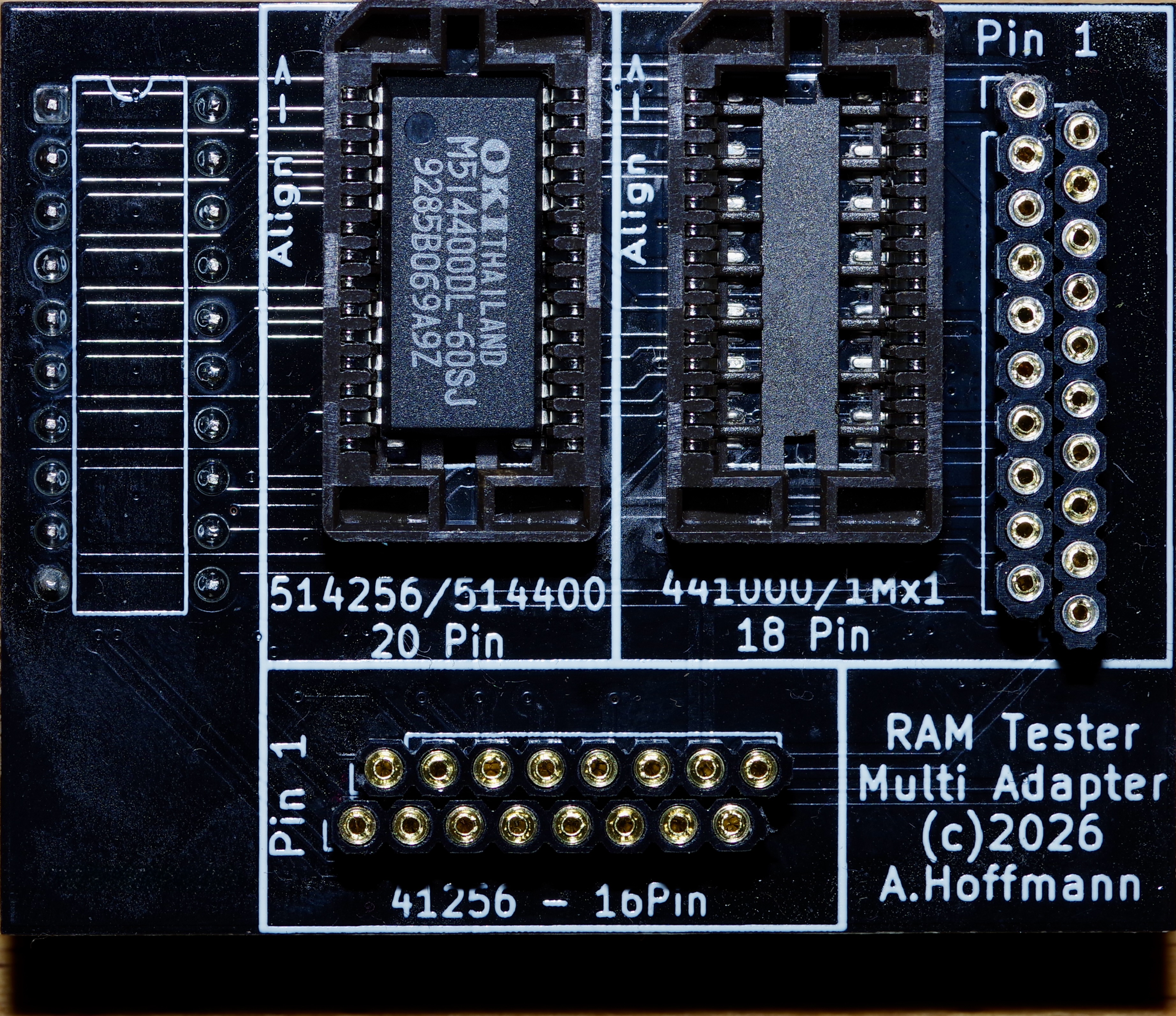
| 44256 / 514256 | 256K × 4 | 4.1 s | Fast Page | DIP & ZIP package |
| 44258 | 256K × 4 | 4.1 s | Static Column | Static column variant of 44256 |
| 514400 | 1M × 4 | 12.8 s | Fast Page | DIP & ZIP package |
| 514402 | 1M × 4 | 12.8 s | Static Column | Static column variant of 514400 |
| 4027 * | 4K × 1 | 1.3 s | Fast Page | * Requires 4116 adapter board |
| 4116 * | 16K × 1 | 1.6 s | Fast Page | * Requires 4116 adapter board |
2114 SRAM support and additional chip types are in active firmware development.
Available directly from the developer — pre-assembled SMD board, fully tested, ready to solder the through-hole components (approximately 30 minutes).
Required for testing 4027 and 4116 DRAM chips. Generates the +12V and −5V rails with built-in protection.
Both the SMD and through-hole versions are available as community PCB projects on PCBWay. All Gerber files, schematics and firmware are on GitHub.
All schematics, PCB files, firmware source code and test algorithms are public on GitHub under GPL v3. Any test claim made on this site can be verified by reading the source code.
This is a deliberate choice: diagnostic equipment is more useful when its methodology is auditable. Users can confirm that the documented tests actually run as described, identify limitations, and modify the firmware for their own use cases.
Pull requests, issues and forks are welcome.